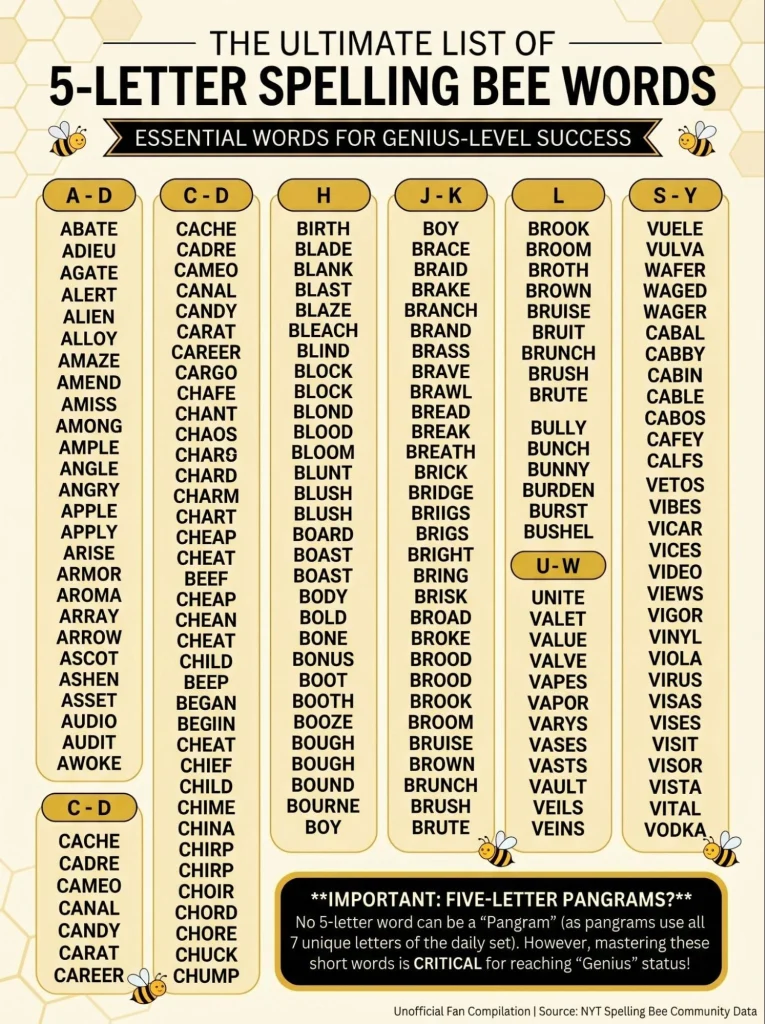
The Ultimate List of 5-Letter Spelling Bee Words
Picture this. You’re up on that huge stage. The microphone is staring right at you. Terrifying, right? Your hands are a sweaty mess. Your heart is pounding out of your chest. The room drops dead silent, and everyone is waiting for you to speak. That right there? That’s the real spelling bee experience.
Most kids panic. They instantly grab the thickest dictionary they can find and try cramming 15-letter monster words into their brains. Words they can’t even pronounce. But let’s be honest. You don’t need to do that yet. The smartest, sneaky-good place to kick off your practice? Yep. Spelling bee 5-letter words.
Five-letter words hit that perfect sweet spot. They aren’t baby words like “cat.” But they won’t melt your brain, either. Don’t fall into the trap of thinking short means easy. Big mistake. Some of the most brutal words in the English language are short. They hide silent letters. They mash weird vowels together. They just flat-out break the rules.
Let’s dig into these tricky little words. We’ll cover the best lists to practice, why they matter so much, and how to snag that first-place trophy without losing your mind.
Why Do Spelling Bee 5-Letter Words Actually Matter?
Why five letters? Why not four? Or nine? Well, there’s a method to the madness. Practicing this specific word length turns you into a much tougher competitor. Here’s why.
When memorizing this ultimate list of five-letter terms, you should always keep the main Spelling Bee Answers platform open to verify your daily scores and track your progress.
They Build Your Groundwork
Think about playing Minecraft or building Legos. You don’t start with the roof. You build the walls first. Five-letter words are your walls. They teach you how weird letter chunks sound when they mash together.
Take the word “light.” Learn that, and you’ve trained your brain on the “ight” sound. Got it down? Boom. Now you can easily spell bigger nightmares like “frightening.” Master the small blocks first, and the big ones become easy.
Silent Letters Will Get You
English loves to mess with us. One big reason kids get knocked out of bees early? Sneaky, invisible letters. And five-letter words are loaded with them.
Look at “ghost.” You hear the G, the O, the S, and the T. But there is a totally useless “h” just chilling in there doing nothing. If you don’t practice these, you’ll spell it “gost” up on stage. Cue the bell. You’re out. Practicing these words trains your eyes to spot the traps.
They Are the Warm-Up Rounds
Judges don’t drop massive medical terms in round one. They want to let everyone breathe. They usually kick things off with four, five, or six-letter words.
Imagine tripping up on a basic five-letter word in the first round because you only studied ten-letter giants! Heartbreaking. Locking down a solid list of spelling bee 5-letter words keeps you alive and safe for the later, harder rounds.
To truly test your knowledge of this new five-letter word list, you can load up older boards from the comprehensive NYT Spelling Bee archive and practice your solving speed.
The Best 5-Letter Spelling Bee 5-Letter Words to Practice Right Now
Ready to study? Grab a pen. We’ve broken these down into easy, medium, and pull-your-hair-out hard. Beyond just five-letter combinations, expanding your vocabulary to include other frequently used common spelling bee words is a great way to consistently boost your puzzle ranking.
Easy 5 Letter Words for Starters
You see these everywhere. You read them. You write them. But stage fright makes your brain freeze. Practice these so you don’t blank out.
- Apple: A crunchy snack. The trap? Forgetting the double “p” when you’re nervous.
- Bread: Sandwich material. Just remember the “e” and “a” hang out together to make that short “e” sound.
- Chair: You sit on it. Do not forget the “i” hiding in the middle!
- House: Where you sleep. Ends with a magic “e” you never hear.
- Mouse: Squeaky cheese-eater. Follows the same rule as the house.
- Plant: Green stuff in the dirt. Sound it out slowly. P-l-a-n-t.
- Smile: Show those teeth. A classic example of the silent “e” making the “i” say its name.
- Table: Dinner time. Ends in “le.” So many kids panic and write “el.” Don’t be that kid.
- Train: Choo choo. The “ai” team makes the long “a” sound.
- Water: Ocean stuff. The “a” sounds a lot like an “o.” Watch out.
Medium Difficulty (Getting Trickier)
Let’s turn up the heat. These have weird vowels or sounds that flat-out lie to your ears.
- Build: Lego time. The “u” is 100% silent. Sounding it out gives you “bild.” And that gets you eliminated.
- Earth: Our planet. The “ear” at the start is confusing because it sounds nothing like the ear on your head.
- Guard: Security. Like “build,” that “u” is just hiding in silence.
- Guess: Taking a shot in the dark. Watch out for that sneaky silent “u” after the “g.”
- Juice: Apple or orange. The “ui” part is a pain, and the soft “c” sounds exactly like an “s.”
- Ocean: Salty waves. “Cea” makes an “sh” sound. Tricky, right?
- Piece: A slice of pizza. Remember the schoolyard rule: “i” before “e” except after “c.”
- Quiet: Shhh. The “ie” makes two separate sounds. Pretty rare to see that.
- Sugar: Sweet stuff. The “s” sounds like “sh.” The “ar” sounds like “er.” Total trap word.
- Weird: Strange. This one breaks the rules! It’s “e” before “i.” Very weird indeed.
The Hardest 5 Letter Words (Boss Level)
Want to impress the judges? Here you go. These are brutal. Most come from other languages, so they throw English rules right out the window.
- Choir: Church singers. Sounds like “kwire.” Spelled with “ch” and “oir.” Yikes.
- Fjord: Deep water between cliffs. It’s Norwegian, so the “j” sounds like a “y.”
- Gauge: To measure. The “au” sounds exactly like a long “a.” Super confusing.
- Gnome: Little garden dude. Silent “g.” If you haven’t studied this, you’ll fail it.
- Khaki: Tan pants. “Kh” at the start is unusual. Ends in “i” instead of “y.”
- Niche: A specific spot. It’s French, so the “ch” makes an “sh” sound.
- Plaid: Flannel shirt pattern. Sounds like “plad” but hides an “i” inside.
- Queue: A waiting line. Maybe the craziest word ever. You only hear the “Q.” The rest of the letters are silent!
- Vague: Blurry. The “gue” just makes a hard “g” sound.
- Yacht: Fancy boat. The “ch” is useless. Sounds like “yot.”
Spelling Rules That Actually Help
Rote memorization gets old fast. If you want to dominate, learn the actual rules. Know the rules, and you can spell words you’ve never even heard before. Understanding the origins of competitive word games by reading about the history of the spelling bee gives you excellent context on why certain short vocabulary terms appear so often.
The Magic "E" Trick
You learned this in first grade. It’s everywhere. When a word ends in “e,” that “e” is usually quiet. But it has a job. It jumps over the consonant and makes the vowel before it shout its own name.
Look at “shape.” Drop the “e,” and you get “shop.” “The magic “e” gives us the long “a.” You see it all the time in grape, smile, and chase.
Doubling Up Consonants
Sometimes words need twin consonants. This usually happens right after a short vowel.
Back to “apple.” The “a” is short, so we double the “p.” If we didn’t, it would look like a magic “e” word, and people would say “ay-ple.” The same goes for happy, puppy, and carry.
The Whole "I Before E" Mess
You know the rhyme. When you hear a long “e” sound and panic over whether it’s “ie” or “ei,” use the trick.
If there’s a “c” right before it, use “ei” (ceiling). No “c” nearby? Use “ie” (thief, piece). But stay alert! Rule-breakers like Weird exist just to ruin your day.
How to Study Without Losing Your Mind
Staring at a dictionary is miserable. And if you’re bored, your brain essentially shuts off. You have to mix it up. Here’s how.
Flashcards with Friends
Grab some index cards and Sharpies. Word on the front, meaning on the back. But don’t sit in your room alone! Grab a friend or a parent. Make it a game. Get it right? One point. They pick a brutal word to trick you, and you still nail it? Two points.
Tablet Games
We all have screens. Use them. Download some free spelling apps. Unscramble letters before the timer runs out. Type words to shoot down space rocks. It beats sitting at a desk doing homework.
Just Read Books
Seriously. The ultimate cheat code for spelling is reading. When you read, your eyes take snapshots of words. Your brain silently memorizes them without you even trying.
Read enough, and misspelled words will literally look “wrong” to you on paper. Grab a comic book or a mystery novel. You’re studying while having fun.
If you get stuck trying to recall a specific five-letter answer during your daily session, utilizing the automated Spelling Bee Solver NYT will instantly reveal the missing letters.
What NOT to Do on Stage
Stage fright makes smart kids do dumb things. Avoid these mistakes at all costs:
- Rushing it: Don’t spit out letters the second the judge stops talking. Breathe. Wait three seconds. Think. Then speak.
- Not asking questions: You can ask for the definition or part of speech. Do it! It gives you massive context clues.
- Staring at the audience: Seeing a hundred eyeballs staring back will make you panic. Look at your shoes. Or just look right at the judge.
- Starting over: Said a letter out loud? You can’t take it back. If you say C-A-T… then realize you meant B-A-T, game over. Go slow.
- Forgetting the sandwich rule: Say the word. Spell the word. Say the word again. “Apple. A-P-P-L-E. Apple.” That tells the judge you are finished.
If you want a slight nudge without fully revealing the answer board, checking the official NYT Spelling Bee hints today provides a helpful breakdown of word lengths and starting letters.
Conclusion
Prepping for a spelling bee is tough. It takes guts to get up there. And yeah, you’re going to mess up a lot while practicing at home. Totally normal. Just don’t quit.
Focusing on spelling bee 5-letter words gives you a massive advantage. You catch the sneaky rules. You spot the silent letters. You build a base that lets you spell absolutely anything later on. So keep reading. Keep playing those word games. When they call your name, take a breath, step up to the mic, and crush it!
Frequently Asked Questions
How many words do I actually need to study?
Don’t memorize the dictionary! Start with 50 to 100 common five-letter words. Nail those, then add the weird ones.
Do short words only happen in round one?
Usually. But judges love throwing a weird short word (looking at you, yacht) into late rounds just to catch people napping.
What if I don't know the word at all?
Ask for a sentence. Hearing it used in real life can knock a memory loose.
How much should I practice?
Fifteen to twenty minutes a day. That’s it. It’s way better for your brain than a four-hour cram session on Sunday night.
Can I pretend to write on my hand?
Absolutely. Tons of champions use their finger to trace the word on their palm before speaking. Seeing the invisible letters helps a ton.