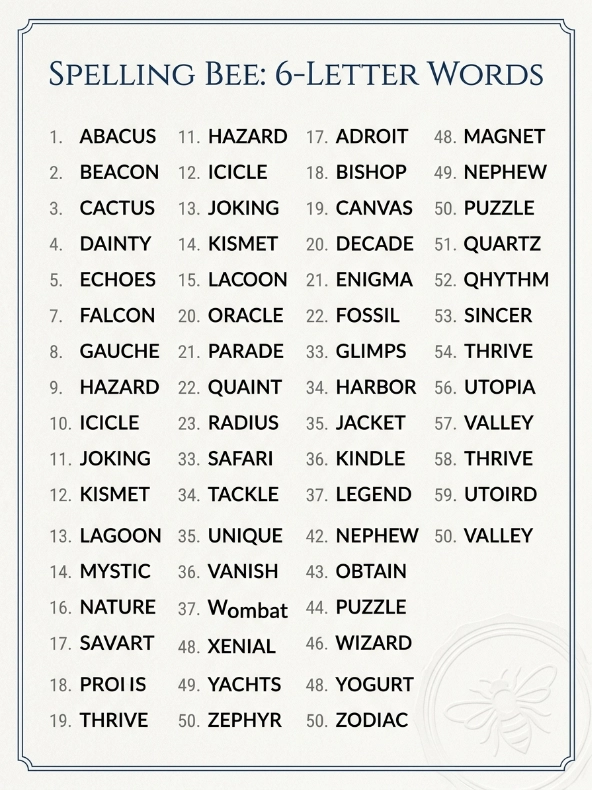
Spelling Bee 6 Letter Words: How to Master the Trickiest Hidden Traps
Picture this. You are standing dead center on a massive stage. The cafeteria is so quiet you can actually hear your own heart thudding, and that microphone is staring you right in the face. The judge flips a little white card and hands you your word. It is only six letters long. Easy, right? You’ve been spelling things correctly since kindergarten. But do not let the short length fool you.
Under those bright lights, those tiny, innocent-looking words turn into absolute monsters. If you actually want to bring home a giant plastic trophy, you have to completely master spelling bee 6-letter words. Judges love them because they act like hidden landmines. They look completely normal when written down on a piece of scratch paper. But when you have to shout every single letter out loud to a room full of staring parents? Your brain just totally freezes.
We are going to tear apart every single thing you need to know about these sneaky little traps. I will show you the exact words that knock out the smartest kids, explain the weird rules hiding inside them, and give you some actually fun ways to practice at home. Go grab a notebook and a pencil. Let’s get to work.
How to Break Down a 6-Letter Word on Stage
All your hard practice is done. Now you are standing on the stage. The super bright lights are shining right on you. The head judge says a six-letter word you have literally never heard before in your life. Your stomach drops to the floor.
Do not panic. You have a massive toolkit you can use. The official spelling bee rules totally allow you to ask the judge a bunch of questions. You absolutely must use them! Never, ever just guess and hope for the best. To check your daily progress or find any remaining words on your grid, visiting the main Spelling Bee answers dashboard will give you the complete list of active solutions.
Step 1: Always Repeat the Word
Always say the word right back to the judge immediately. Make sure you heard them 100% correctly. If you say it wrong, the judge will stop you and correct you before you start spelling. This simple step saves you from making a really silly mistake just because you misunderstood what they said.
Step 2: Ask for the Official Definition
A ton of words sound the same when spoken but are spelled totally differently. These are called homophones. If the judge says “fleece,” you desperately need to know if they mean the sheep’s wool coat (fleece) or the itchy bugs jumping on your dog (fleas). Getting the definition locks in the right word in your brain.
Step 3: Ask for the Language of Origin
This is hands-down the most powerful question you can ask any judge. English is basically a giant, messy soup of other foreign languages.
- If the judge says the word is from Greek, an “f” sound is almost definitely spelled with a “ph”.
- If they say the word is from French, a hard “k” sound at the end of the word is usually spelled “que”.
- If the word comes from German, a “v” sound might actually be spelled with a “w”.
Knowing exactly where the word came from gives you a massive, neon clue about how to build it.
Step 4: Ask for a Sentence
Hearing the word used out loud in a real sentence gives your brain amazing context. It helps you try to picture the word printed in a book. It also buys you a little extra precious time to calm down and think. Plus, sometimes the sentence the judge reads is just really funny and helps you stop shaking.
Step 5: Write it on Your Hand First
You can’t bring a pencil or paper on stage with you. But you have a hand! Before you say a single letter into the microphone, use your finger to silently trace the word on the palm of your hand. Look down at it. Does it look right to your eyes? If it looks weird or ugly, fix it in your head before you speak.
Why Do We Care So Much About Spelling Bee 6 Letter Words?
You might be sitting there wondering why we are focusing so much on six-letter words right now. Why not practice the five-letter ones? Why not jump to the crazy ten-letter words that high school kids get?
It actually makes perfect sense when you step back and look at how these spelling competitions are put together. Six-letter words act like the ultimate bridge in a bee. They sit perfectly right in the middle between super-easy beginner words and those crazy-hard dictionary words nobody uses in real life.
Here is exactly why they matter so much for your success:
- They hide really sneaky rules: A tiny three-letter word is usually spelled exactly the way it sounds when you say it. But a six-letter word? It is just long enough to hide a completely silent letter or some weird double vowel combination that makes zero sense.
- They end rounds fast: Judges absolutely love using these words to knock kids out of the competition early. When they want to eliminate a bunch of spellers before they get to the final championship round, they start pulling out the tricky six-letter words.
- They test what you actually know: You cannot just guess these words and get lucky. You actually have to know the weird, old rules of the English language to get them right on the first try.
If you can learn to completely dominate the six-letter category, you are setting yourself up for some serious spelling success. You build up a massive foundation of knowledge. And honestly? Knowing you can crush these words gives you a giant boost of confidence when you step up to the mic.
The Huge Danger of Overconfidence
Here is a massive trap I see smart kids fall into all the time. They spend weeks practicing massive, fourteen-letter words. They spend hours and hours learning how to spell crazy medical terms and weird scientific plant names. Then, the big day comes. They walk up to the microphone. The judge smiles and gives them a really simple-sounding six-letter word.
Because they spent all their time practicing dictionary words and ignored the basics, they totally panicked. They randomly add an “e” that doesn’t belong there. Or they totally forget a silent letter. Ding. You hear the terrible bell sound. They are out of the bee.
Do not let that happen to you. Respect the short words.
When hunting for mid-length terms, studying a list of common spelling bee words helps you spot recurring suffixes and letter patterns that editors love to repeat.
How to Actually Memorize Spelling Bee 6 Letter Words Fast
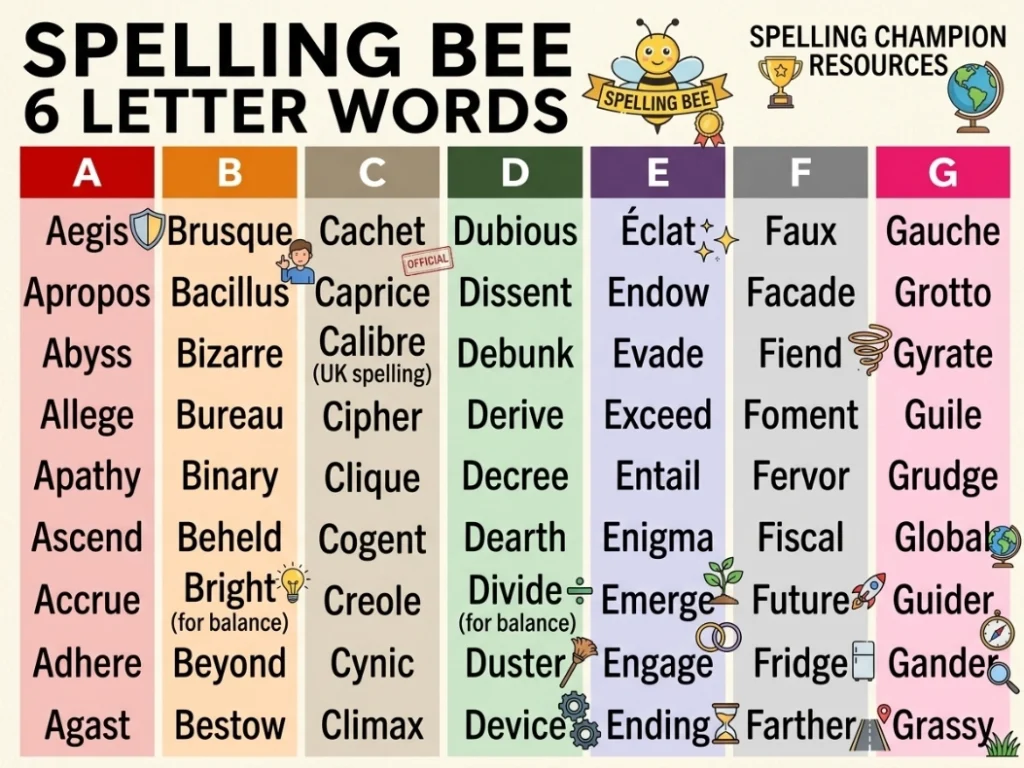
Okay. Now you are looking at a giant list of words. What are you supposed to do with them?
You cannot just sit there, stare at a piece of paper, and hope they magically stick inside your brain. That literally never works for anybody. Your brain needs to be active. You have to totally trick yourself into having fun while you are learning. Here are the absolute best, most effective ways to lock these tricky words inside your memory forever.
Read Real Books Every Single Day
This is the biggest, most important secret in the whole spelling bee world. The absolute best spellers are always the kids who read the most books. Why? Because they actually see these words living in their natural habitat.
When you read a word in a great story, your brain takes a quick picture of it. You slowly start to naturally learn what a word is supposed to look like when it is spelled right. If a word is spelled wrong on a sign, it will just look “ugly” or “wrong” to your eyes. That instinct comes completely from reading. Pick up cool chapter books, sports magazines, or even interesting news articles. Just make sure you read.
Keep Your Own Personal Word Journal
Do not just use pre-made lists you found on the internet. You need to make your own list. Go buy a small, cheap notebook. Every single time you find a word in a book that you don’t know, or a word that tricks you on a practice test, write it down immediately.
- Write the word out super clearly in big, bold letters.
- Write down the dictionary definition.
- Write down the tricky part. Highlight it! If the “h” is completely silent, circle that “h” with a bright red marker.
- Write a super silly, funny sentence using the word. The funnier your sentence is, the easier it is for your brain to remember.
Trace the Words in the Air
This sounds a little bit crazy, but I promise it works like total magic. When you are sitting at home trying to learn a brand new word, close your eyes. Put your pointer finger up in the air. Pretend you are writing the letters of the word on a giant, invisible chalkboard in front of you.
Doing this actually builds muscle memory. Sometimes, when you are standing on stage and your brain completely goes blank from stage fright, your hand will actually remember exactly how to spell the word for you. It is a crazy, powerful trick.
Group Your Words by Their Rules
Do not just study a bunch of random words. Put them into families. Study all the tricky words with a silent “k” at the same time (like Knight, Knack, and Knead). Study all the weird French words ending in “que” at the same time (like “plaque,” “unique,” and “mosque”).
When you study them in distinct groups, you start to learn the actual rules of the language. You finally stop memorizing random letters and start truly understanding exactly how words are built from the ground up.
While modern digital puzzles focus mostly on quick daily wordplay, learning about the history of the spelling bee shows how these traditional language challenges evolved over the years.
The Biggest Mistakes Kids Make with 6 Letter Words
I have watched hundreds of spelling bees over the years. I always see kids make the same silly mistakes over and over again. If you know exactly what the traps are, you can easily jump right over them.
Mistake 1: Speeding Through the Word
You get a word you practiced last night. You get super excited. You just want to scream the letters out into the mic and run back to your safe seat. So you talk super, super fast.
“V-A-C-U-M. Vacuum!”
Ding. You missed the second “u”. You knew the word perfectly, but your mouth moved way faster than your brain. Always pace yourself. Say the letters out loud with a nice, steady rhythm. One. Two. Three. Four. Five. Six.
Mistake 2: Second-Guessing Yourself at the Last Second
You trace the word out on your hand. It looks totally perfect. But then that annoying little voice in the back of your head whispers, “Wait a minute, is there a double letter in there?” You change your mind at the very last second.
Usually, your very first instinct is the right one. Your brain recognizes the pattern from all your long hours of reading. Trust your gut. Do not completely change your spelling at the last second unless you suddenly remember exactly why the other way is 100% absolutely right.
Mistake 3: Forgetting to Say the Word at the Very End
In most normal spelling bees, the official rules say you have to say the word out loud, spell it letter by letter, and then say the word again at the end. It lets the judges know you are finished. Sometimes, nervous kids spell the word perfectly, but then they just stand there frozen in silence. It gets super awkward. Get into the habit of ending really strongly. “Knight. K-N-I-G-H-T. Knight.”
To practice finding tricky word traps from older puzzles, spending time training in the NYT spelling bee archive is an excellent way to sharpen your memory.
Fun Practice Games to Actually Master Your Word List
Let’s just be completely real here. Staring at a boring black and white list of words gets really old, really fast. If you are bored out of your mind, you won’t learn a thing. You need to mix things up and make it super fun. Try playing these awesome games with your parents, brothers, or friends.
Spelling Ping-Pong
You need two people for this game. You pick a word from your list. Let’s use “Rhythm.” You say the very first letter, “R”. Your friend quickly says the next letter, “H”. You say “Y”. You bounce back and forth like a ping-pong ball until the work is done.
It completely forces you to slow down your brain. You cannot just rely on pure muscle memory. You have to actually see the entire word printed in your head to know what exact letter comes next. It is so much harder than it sounds!
The Post-It Note Challenge
Go to the store and get a giant pack of bright, neon sticky notes. Write your absolute hardest six-letter words on them in big marker. Now, stick them all over your house. Put “Plaque” right on your bathroom mirror so you see it when you brush your teeth. Put “Vacuum” physically on the actual vacuum cleaner. Put “Tongue” right on the fridge door.
Every single time you walk past a note, you have to read the word, completely close your eyes, and spell it out loud. You will see these crazy words constantly throughout your whole day.
Wild Word Scramble Races
Have your parents write your hardest spelling words on blank index cards, but with the letters totally scrambled up in a weird order. Set a kitchen timer for exactly three minutes. See how many cards you can successfully unscramble and spell correctly before the loud timer goes off. It heavily trains your brain to quickly recognize letters in a weird order and put them back together fast.
Before jumping into longer combinations, mastering shorter sets like 5 letter spelling bee words builds a strong foundation for managing your puzzle board effectively.
Conclusion
Preparing for a giant school spelling bee takes some serious, heavy dedication. It takes time, it takes a lot of patience, and it takes a whole lot of fun practice. But I can promise you right now, all that hard work totally pays off when you hold that certificate.
When you decide to focus deeply on spelling bee 6-letter words, you build an absolutely incredible foundation for the future. You learn all the secrets about silent letters, weird hidden vowels, and cool words borrowed from all over the world. You finally stop just guessing on stage and start actually understanding how words work.
So grab a good book. Start writing in your cool new word journal. Play some super fast spelling ping-pong with your best friend. The very next time you walk up to that scary microphone and the judge hands you a tricky six-letter word, you won’t panic. You will just smile. Because you know exactly what to do. You’ve totally got this. Good luck out there!
If you get stuck on the final few combinations needed to hit Genius rank, using an automated spelling bee solver NYT tool can reveal any hidden terms you might have overlooked.
Frequently Asked Questions
Are six-letter words really the hardest ones to spell?
Well, they definitely aren’t the longest words in the book, but they can absolutely be the trickiest. Huge, terrifying words like “supercalifragilisticexpialidocious” are actually pretty easy to spell if you just break them down, because they sound exactly like they are spelled. Six-letter words are just short enough to hide really nasty, invisible tricks. They require real, serious memory, not just sounding it out phonetically.
How many words should I honestly study every single day?
Please don’t overdo it. If you try to learn a hundred new words in one single day, your brain will melt, and you will forget ninety of them by tomorrow morning. Stick to 10 to 15 brand new words a day. Master them completely. Then, just casually review them at the end of the week. Slow and steady always wins the race in spelling.
What is the absolute hardest six-letter word to spell in the dictionary?
It really depends on the person and what they find tricky, but words like “rhythm” and “phlegm” are usually sitting right at the top of the list for most kids. They completely break all the normal, safe rules of English vowels and consonants. If you can spell those two words perfectly without sweating, you are in really, really good shape.
Is it actually okay to ask the judge to repeat the word multiple times?
Yes! Absolutely, 100%. You can ask them to repeat the word as many times as you possibly need within your time limit. If the gym is echoing loudly or the judge has a weird accent you aren’t completely used to hearing, ask them to say it again clearly. It is your time on that stage. Use every second of it to get completely comfortable before you spell.